Loan for Solar Panels: Best Loan Types (and How to Qualify)

Find Out What You’d Actually Be Financing
Qualifying for a loan is easier once you know the real system cost for your roof. A local quote gives you that number before you start comparing loan types.
Disclosure: we may earn a commission if you switch or request a quote through this link, at no extra cost to you. It never changes which plan or company we recommend. How we make money.
Thinking about getting solar panels for your home? That’s awesome! It’s a big step towards saving money and helping the environment. But, let’s be real, those panels aren’t exactly cheap upfront. Luckily, there are a bunch of ways to finance them. You might be wondering, ‘What’s the best loan for solar panels?’ Well, it really depends on where you live and what you qualify for. We’ve rounded up some of the top options out there to help you figure it out.
Key Takeaways
- PACE programs let you pay for solar upgrades through your property taxes, making it easy to add to your home’s value.
- A Home Equity Line of Credit (HELOC) uses your home’s equity as collateral, potentially offering lower interest rates.
- State green banks and energy offices run some of the cheapest solar loans in the country, and most people have never heard of them.
- Credit unions built for clean energy lend larger amounts over longer terms than a bank will, without using your house as collateral.
- There is no federal tax credit for a 2026 purchase, so whatever you borrow is what you pay.
- Lease-to-own and Power Purchase Agreements (PPAs) are alternatives where you don’t own the panels outright but still benefit from solar energy, often with little to no upfront cost.
1. Property-Assessed Clean Energy (PACE) Programs
Check availability first. Residential PACE has shrunk. As of 2026 it runs in California and Florida only. Missouri closed its residential programme in August 2024. If you are not in one of those two states, this route is not open to you and you can move on to the next one.
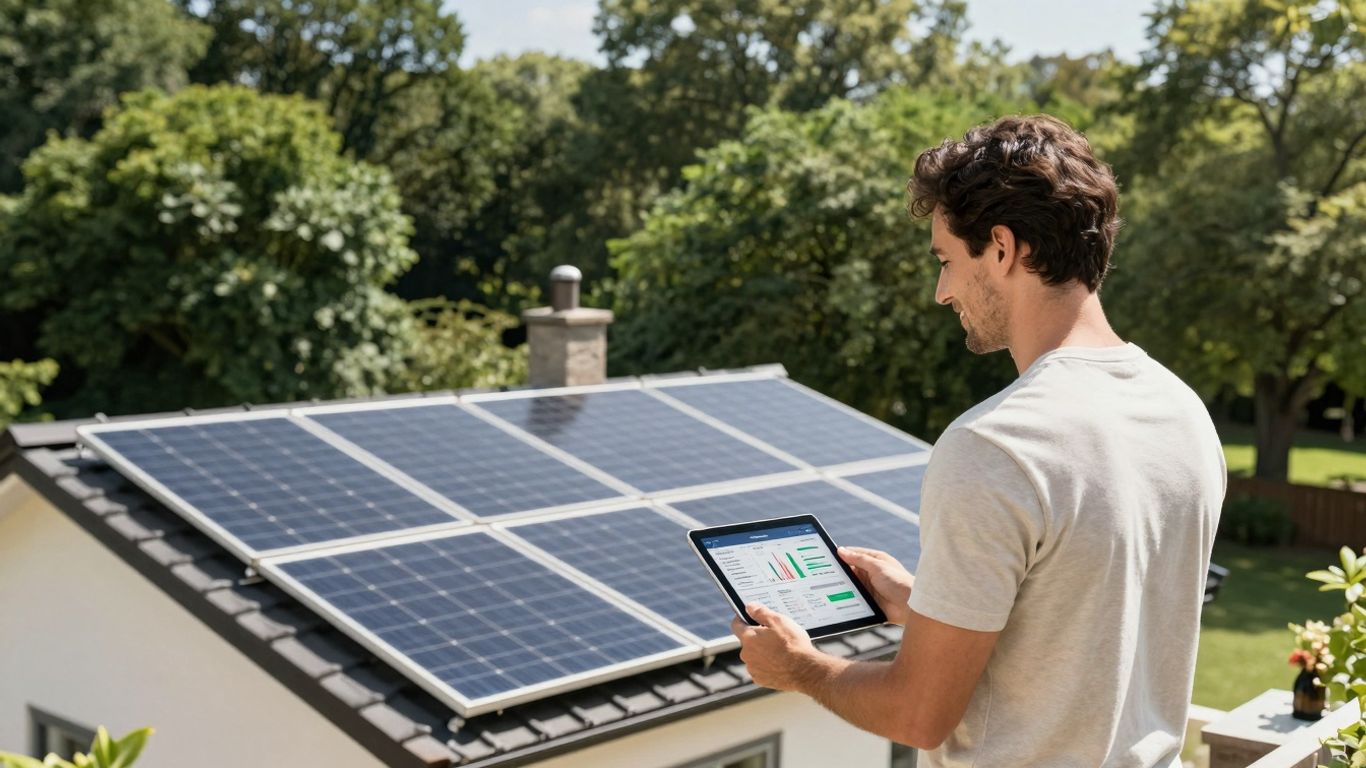
Visualizing How A Solar Panel Loan Can Lead To Net-Positive Monthly Savings Within Five Years.
Property-Assessed Clean Energy, or PACE, programs are a way to finance energy-efficient upgrades, including solar panels, where the cost is added to your property tax bill. This means the loan is tied to the property, not to you personally, which can make it easier to qualify and transfer if you sell your home.
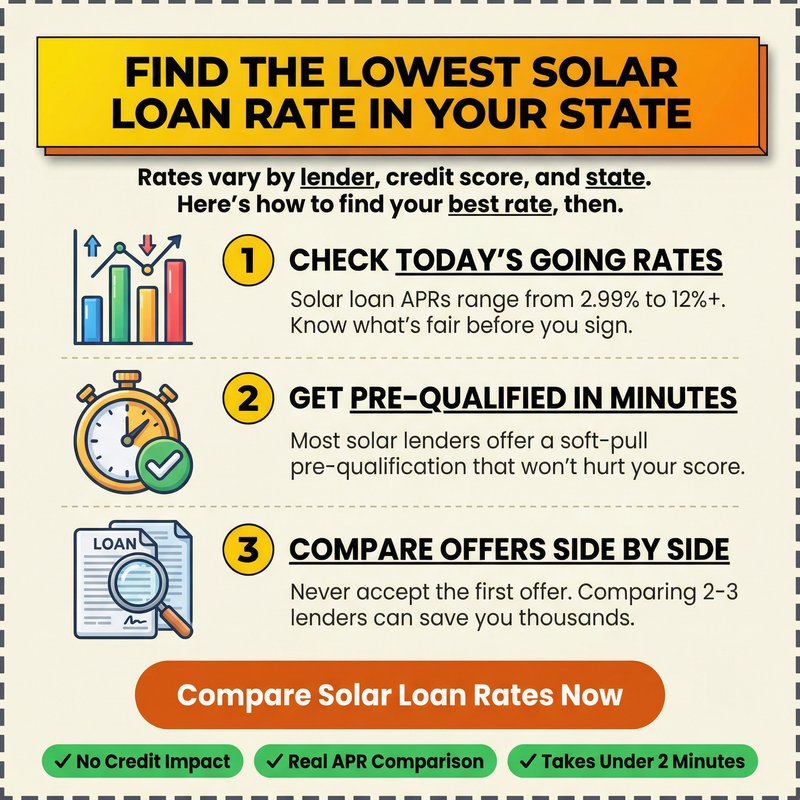
Residential PACE is run at state and county level, and it has contracted rather than spread. Two states offer it in 2026, and within them it still depends on your county having opted in, so confirm before you plan around it.
Credit unions are the other route worth checking alongside municipal programmes. We look at what one national credit union asks for on credit score and membership in our Credit Human review.
Here’s how they generally work:
- Assessment: Your property is assessed to see if it qualifies for the program.
- Installation: You work with an approved contractor to install your solar panels or other eligible upgrades.
- Repayment: The cost of the project is repaid over a set number of years through your regular property tax installments.
- Transferability: If you sell your home, the remaining balance of the PACE assessment can be transferred to the new owner.
Limits and terms vary by programme. Repayment periods commonly run to 20 years and sometimes 30, and the amount you can borrow is usually tied to your property value and existing equity rather than your income. Check the terms with your county assessor or the programme administrator directly, not with the contractor selling you the system.
PACE programs can be a really straightforward way to pay for solar if your municipality offers one. Because the assessment is on the property, it often bypasses some of the stricter credit checks you might face with other types of loans. It’s like making your house pay for its own upgrade over time.
2. Home Equity Line of Credit (HELOC)
A Home Equity Line of Credit, or HELOC, is a flexible loan that lets you borrow against the equity you’ve built up in your home. Think of it like a credit card, but for a much larger amount and secured by your house. You get a credit limit, and you can draw funds as needed, paying interest only on what you use. This can be a good option for solar panel installation if you have a significant amount of equity in your home and want the flexibility to draw funds over time.
The main advantage of a HELOC is its adaptability; you can borrow, repay, and borrow again up to your credit limit. This makes it useful if your solar project has multiple phases or if you want to cover unexpected costs that might pop up during installation.
Here’s a quick look at how it generally works:
- Accessing Funds: You can usually access your HELOC funds through checks, online transfers, or a special card. It’s not a lump sum like a traditional loan.
- Interest Rates: HELOCs often have variable interest rates, meaning they can go up or down based on market conditions. This can be a risk if rates climb significantly.
- Repayment: During a draw period, you might only need to make interest payments. After that, you enter a repayment period where you pay back both principal and interest.
Qualifying for a HELOC typically involves a good credit score, a stable income, and a low debt-to-income ratio. Lenders will also look at how much equity you have in your home, the difference between your home’s value and what you owe on your mortgage. Generally, you’ll need to have at least 20% equity to qualify.
While a HELOC offers great flexibility, remember that your home is collateral. If you can’t make payments, the lender could foreclose on your house. It’s important to have a solid plan for repayment and to only borrow what you’re confident you can pay back.
3. State Green Banks and State Energy Office Loans
These are the cheapest loans most homeowners never find, because they are not advertised by installers. A state green bank borrows at public rates and lends the money on to households, so the rate is usually well below a dealer offer and there is no dealer fee buried in it.
Two examples of how they work:
- Connecticut Green Bank, Smart-E Loan. Up to $50,000, unsecured, no closing costs. Solar is around 6.99% APR over 5 to 10 years, or roughly 7.49% to 7.99% over 12 to 15 years. It is delivered through local credit unions and community lenders, and those partners will look at scores from about 580.
- Michigan Saves. $1,000 to $50,000, unsecured, a fixed rate capped at 7% APR, and terms up to 180 months. You have to use one of their authorised contractors, which is a constraint but also a filter.
Most states have something. The names differ and so do the terms, so search for your own state’s green bank or energy office before you accept any installer’s financing.
4. Clean Energy and Community Credit Unions
Some credit unions exist specifically to lend for clean energy, and they will go further than a bank on both size and term.
Clean Energy Credit Union, as an example, lends up to $125,000 at a fixed rate with terms out to 20 years. Their everyday solar loan starts around 7.50% APR on a 12-year term, 8.00% on 15 years and 8.25% on 20 years, and those figures already include a 2% discount for paying by automatic transfer.
The appeal is that it is unsecured. Your house is not collateral, so a missed payment is a credit problem rather than a foreclosure problem. You will need to join the credit union, which is usually a small one-off step.
5. Cash-Out Refinance
If you have owned your home for a while and mortgage rates have moved in your favour, refinancing for more than you owe and taking the difference in cash can be the cheapest money available. Mortgage rates are normally below any solar loan rate.
Two catches. You are spreading a 25-year asset over a 30-year mortgage, so you may still be paying for the panels after they have been replaced. And closing costs are real, typically a few thousand dollars, so this only makes sense if the rate on the whole loan improves, not just the extra part.
6. Unsecured Personal Loans
Any bank, credit union or online lender will write you a personal loan, and you can spend it on anything. Rates are higher than a green bank or a secured loan, often in the low double digits, and terms are shorter, usually five to seven years.
It is worth having as a comparison anyway. If an installer’s financing costs more than a plain personal loan from your own bank, that tells you exactly how large the dealer fee is.
7. Installer and Dealer Financing
This is what most people are offered, because the installer earns on it. GoodLeap, Mosaic, Dividend and Sunlight Financial are the names you will see on the paperwork.
It is convenient and the approval is quick. The cost is hidden in the price rather than the rate. A headline 2.99% is paid for by a dealer fee, often 15% to 20% of the system, folded into the amount you borrow. You do not see it as a fee, you see it as a bigger number to repay.
The one question that exposes it: ask for the cash price of the same system, in writing. The gap between that and the financed amount is the fee. Then compare that total against a green bank or credit union offer for the cash price.
8. Utility On-Bill Financing
Some electric utilities and rural electric cooperatives will finance efficiency and solar work and collect the repayment through your monthly electricity bill. Rates are often low or zero because the programme exists to reduce demand rather than to earn money.
Availability is patchy and usually depends on your specific utility rather than your state, so it is worth ten minutes on your provider’s website. Read whether the obligation stays with the property or with you when you move.
9. What the End of the Federal Credit Changed
Until the end of 2025 a buyer could treat roughly 30% of the system as money coming back at tax time, and lenders built products around that, including balloon payments due once the credit landed.
Section 25D was repealed for anything installed after 31 December 2025. A homeowner who buys or finances in 2026 gets no federal residential credit. Whatever the quote says, that is the amount you are financing.
Two practical consequences. If a lender still shows a balloon payment you are expected to cover with a tax credit, ask in writing which rule they are relying on. And if a salesperson subtracts 30% from your 2026 quote, they are either out of date or hoping you are.
The credit did not disappear from solar altogether. It moved to whoever owns the system, which is why the next option is worth a closer look than it used to be.
10. Lease-to-Own and Power Purchase Agreements
Sometimes, buying solar panels outright just isn’t in the cards. That’s where lease-to-own and Power Purchase Agreements (PPAs) come in. Think of it like leasing a car, but for your roof. You get the benefits of solar power without the big upfront cost.
With a lease, you pay a fixed monthly fee to use the solar system installed on your property. A PPA is a bit different; you pay for the electricity the panels generate, usually at a set rate. The company that owns the panels handles installation and maintenance, which is a pretty sweet deal.
These agreements typically last between 10 to 25 years. At the end of the term, you usually have a few options: you can buy the system, extend the agreement, or have it removed. It’s important to know what these options are before you sign anything.
Here’s what you should really pay attention to:
- Agreement Length: How long are you locked in?
- End-of-Term Options: What happens when the contract is up? Can you buy it? Extend it?
- Cost vs. Savings: Does the monthly payment make sense compared to how much you expect to save on electricity bills?
- Moving: What happens if you sell your house? Leases aren’t always transferable, so you’ll need to understand the terms for breaking the agreement.
It’s a good idea to have a lawyer or a financial advisor look over any lease or PPA documents before you commit. They can help you spot any tricky clauses or make sure the deal is truly beneficial for you.
Wrapping Up Your Solar Panel Financing Journey
So, getting solar panels for your home is definitely a big step, and figuring out the money part can seem a bit much at first. We’ve looked at different ways to pay for it, from specific government programs to loans you can get from your bank. Remember to check out what’s available in your area, because things like PACE programs or local energy efficiency loans can make a big difference. Don’t forget about options like leases or PPAs if buying outright isn’t in the cards right now, but be sure to read the fine print on those. Ultimately, finding the right loan means looking at interest rates, repayment terms, and what fits your budget best. It might take a little digging, but getting those panels up and running is totally worth it for the long run.
Frequently Asked Questions
What is a PACE program?
PACE stands for Property-Assessed Clean Energy. It’s a way to finance green upgrades like solar panels. The loan is usually paid back through your property taxes, making it easier to manage.
How does a HELOC work for solar panels?
A Home Equity Line of Credit (HELOC) lets you borrow money using the value of your home. You can use this line of credit to pay for solar panels, and you pay it back over time, often with flexible payment options.
What’s the difference between a lease and a Power Purchase Agreement (PPA)?
With a lease, you pay to use the solar panels on your roof. With a PPA, a company installs panels on your property, and you buy the electricity they produce at a set price. Both let you get solar with little to no upfront cost.
Are there loans specifically for energy efficiency upgrades?
Yes! Many places offer special loans for things like solar panels and other energy-saving improvements. These often have lower interest rates and longer payback periods.
How do I qualify for these solar loans?
Qualification usually depends on your credit score, income, and whether you own your home. Some programs might have specific requirements, so it’s good to check with each one.
What happens if I sell my house with a solar loan?
This depends on the loan type. Some loans, like PACE, are tied to the property and transfer to the new owner. Others might need to be paid off when you sell. Always check the loan agreement.
Qualifying is one half of it. The other half is the main solar panel financing options explained, and getting a solar loan from a credit union.
Ready to Start Saving on Your Energy Bills?
Get a free, no-obligation quote from trusted local providers in under 2 minutes.
No obligation • Free estimates • Takes under 2 minutes
Want real quotes before you decide how to pay for it?
A loan only makes sense once you know what the system will actually cost. If your electric bill runs above $150 a month and your roof gets decent sun, a personalized quote gives you real numbers to put into any loan comparison. Quotes are available nationwide.
Recent Posts
- Pennsylvania electricity supplier complaints: How to document, file, and resolve a billing dispute
- What happens when my electricity contract ends in Pennsylvania? A practical guide
- Pennsylvania electricity early termination fees: what to check before canceling your contract
- Power to Choose in Texas: How to compare electricity plans and rates
- How to read your Texas energy bill: A plain-English guide to every charge and fee