Solar Financing Options: Loans, Leases & Payment Plans Compared
See Real Numbers Before You Pick a Financing Option
Loans, leases, and PPAs all work differently, and the right pick depends on your roof, your bill, and your credit. A quote from a local installer gives you actual costs to run through each option.
Disclosure: we may earn a commission if you switch or request a quote through this link, at no extra cost to you. It never changes which plan or company we recommend. How we make money.
Thinking about putting solar panels on your roof? That’s great! It’s a big step towards saving money on electricity and helping the environment. But, like anything big, it costs money upfront. The good news is there are several ways to pay for it, not just one lump sum. We’re going to look at the main solar financing options out there, like loans, leases, and other plans, to help you figure out what works best for your wallet and your home. It’s all about making a smart choice that pays off.
Key Takeaways
- Owning your solar system through a loan usually means more savings in the long run, often two to three times more than other options.
- Loans let you claim tax credits and can increase your home’s value, plus payments don’t go up over time.
- Leases and Power Purchase Agreements (PPAs) require little to no money down and handle maintenance, but you don’t get tax benefits and long-term savings are usually lower.
- When choosing, think about your budget, how long you plan to stay in your home, and if you want to own the system or just use the power it generates.
- Don’t forget about incentives like tax credits and net metering. They can make a big difference in how much you save, no matter which financing option you pick.
Understanding Your Solar Financing Options
Thinking about putting solar panels on your roof is a big step, and figuring out how to pay for it can feel a little overwhelming at first. It’s not just about the panels themselves; it’s about how you’re going to fund this investment in your home and the planet. Luckily, there are several ways to go about it, each with its own set of pros and cons. The best choice really depends on your personal financial situation and what you hope to get out of going solar. Let’s break down the main ways people finance solar energy systems.
The Appeal of Solar Energy
Why are so many people looking into solar these days? For starters, electricity bills can be a real pain, and solar offers a way to take control of those costs. Plus, there’s the environmental angle, using clean energy from the sun is a pretty good feeling. It’s about saving money over time and doing something good for the environment. Many homeowners also see it as a way to make their homes more valuable.
Key Considerations Before Choosing
Before you even start looking at financing, it’s smart to think about a few things. How much electricity do you actually use? What’s your budget like, not just for today but for the next 10, 20, or even 25 years? How long do you plan to stay in your home? These questions can really guide you toward the right financing path. It’s also worth checking out what tax credits or local rebates might be available, as these can significantly change the numbers.
Here are some points to ponder:
- Your Credit Score: This will heavily influence the types of loans you can get and the interest rates you’ll pay.
- Your Tax Liability: If you have a significant tax bill, you’ll be in a better position to take advantage of tax credits.
- Homeownership Duration: If you plan to move soon, some options might be less ideal than if you’re settled for the long haul.
- Tolerance for Risk: Are you comfortable with potential payment increases over time, or do you prefer a fixed, predictable cost?
Navigating the Landscape of Solar Financing Options
When you start researching, you’ll find a few main categories of financing. You’ve got options where you own the system outright, and then there are options where a third party owns and manages it. Each has its own way of working and its own set of benefits. It’s not a one-size-fits-all situation, so understanding the differences is key to making a smart decision for your home.
Here’s a quick look at what’s generally available:
- Cash Purchase: You pay the full amount upfront. Simple, and often the most cost-effective long-term.
- Solar Loans: You borrow money to buy the system and pay it back over time with interest.
- Solar Leases: You pay a monthly fee to use a system installed on your roof, but you don’t own it.
- Power Purchase Agreements (PPAs): Similar to a lease, but you pay for the electricity the system produces at a set rate, rather than a fixed monthly payment for the equipment.
Choosing how to finance your solar system is a significant decision. It’s easy to get caught up in the excitement of saving money and helping the environment, but taking a moment to really understand the financial mechanics of each option will save you headaches down the road. Think of it like buying a car. You wouldn’t just pick the first one you see without checking the price, the features, and how you’re going to pay for it.
Exploring Solar Ownership Through Loans
When you think about owning your solar setup, a solar loan is probably the first thing that comes to mind. It’s pretty straightforward: you borrow money to buy the system, and then you pay that money back over time. Unlike leases or power purchase agreements where someone else owns the panels on your roof, with a loan, you own them from day one. This means all the benefits, like tax credits and increased home value, are yours.
Benefits of Securing a Solar Loan
Getting a solar loan means you’re taking the ownership route. This usually leads to bigger savings down the road compared to leasing. Plus, you can claim all the available tax credits and incentives, which can really cut down the overall cost. Your home’s value might get a nice bump too, since you’ve added a valuable asset.
- Immediate Ownership: You own the system outright from the start.
- Tax Credit Eligibility: You can claim federal, state, and local incentives.
- Higher Long-Term Savings: Typically, owning solar panels through a loan results in greater savings over the system’s lifespan.
- Increased Home Value: Adding a solar system can make your home more attractive and valuable.
- No Escalating Payments: Your payments are usually fixed, unlike some leases that can go up over time.
One of the biggest pluses of a solar loan is that you get to take advantage of all the government incentives. These can significantly reduce the initial cost of your system, making it a much more attractive investment. It’s like getting a discount before you even start saving on your electricity bills.
Types of Solar Loans Available
There are a couple of main ways solar loans are structured. The first is a secured loan. This is where the loan is backed by an asset you own, like your house. Because the lender has this security, secured loans often come with lower interest rates and longer repayment terms. You can usually get these from banks, credit unions, or sometimes even the solar company itself.
The other type is an unsecured loan. This one isn’t backed by any specific asset. Since it’s a bit riskier for the lender, unsecured loans might have higher interest rates and shorter payback periods. These are often offered by solar companies as a way to make it easier for people to go solar without needing collateral.
Here’s a quick look at what might influence your loan:
| Factor | Details |
|---|---|
| Credit Score | Generally 650+ for the best rates, but varies by lender. |
| Interest Rate | Can range from 4% to 12% or more, depending on your credit and loan type. |
| Loan Term | Typically 5 to 25 years. Longer terms mean lower monthly payments. |
| Down Payment | Some loans require none, others might ask for a small percentage. |
| Lender Type | Banks, credit unions, solar installers, or third-party financiers. |
What to Look For in a Solar Loan
When you’re shopping around for a solar loan, don’t just grab the first offer you see. It’s really worth comparing a few different options. Pay close attention to the interest rate. That’s a big one that affects how much you’ll pay back over time. Also, check out the loan term, which is how long you have to pay it off. A longer term means smaller monthly payments, but you’ll likely pay more interest overall. Some loans might have origination fees or other charges, so read the fine print.
It’s also a good idea to see if the lender has experience with solar projects. They might offer better terms or be more helpful if you have questions specific to solar installations. Some lenders even bundle in services like system monitoring or maintenance plans, which could be convenient. Make sure the monthly payment fits comfortably into your budget, not just now, but for the entire life of the loan. You don’t want to be struggling to make payments years down the line.
Evaluating Solar Leases for Your Home
So, you’re thinking about solar panels but maybe the idea of a big upfront payment feels a bit much. That’s where solar leases come in. They’re a popular choice because they let you get the benefits of solar energy without needing a pile of cash to start. Basically, you agree to pay a monthly fee to a company that owns and maintains the solar system on your roof. It’s kind of like renting the panels.
How Solar Leases Work
With a solar lease, a third-party company installs and owns the solar panels on your property. You then pay them a fixed monthly amount to use the electricity the panels generate. This means you don’t have to worry about buying the equipment, installation costs, or any future maintenance. The lease agreement typically lasts for 20 to 25 years, and during that time, the company is responsible for keeping the system running smoothly. You’ll see a reduction in your electricity bill right away, which is the main draw for many people.
Advantages of Leasing Solar Panels
There are definitely some good points to leasing. For starters, the biggest perk is usually no upfront cost. You can start saving on your electricity bills from day one without a large initial investment. Plus, maintenance and repairs are generally covered by the lease provider, taking a load off your mind. It’s also usually pretty straightforward to transfer the lease to a new homeowner if you decide to sell your house, which can be a big plus.
Here are some of the key benefits:
- Zero Down Payment: Get solar without needing to spend a lot of money upfront.
- Predictable Monthly Costs: Your lease payment is usually fixed, making budgeting easier.
- Maintenance Included: The leasing company handles upkeep and repairs.
- Transferability: The lease can often be passed on to the next owner of your home.
One thing to really watch out for with leases is the annual escalator. This is a clause that allows the lease payment to increase each year, usually by a small percentage. While it’s often designed to keep pace with rising utility rates, it can mean your savings diminish over the life of the lease compared to owning the system outright. It’s important to understand exactly how this works before signing anything.
When a Solar Lease Might Be Ideal
A solar lease could be a great fit for you if you’re looking for immediate savings on your electricity bills and don’t have the funds for a large upfront purchase. It’s also a good option if you prefer not to deal with the responsibilities of system ownership, like maintenance or potential repairs. If you’re not planning on staying in your home for a very long time, say less than 10 years, a lease can be a practical way to benefit from solar without the long-term commitment of ownership. It’s a way to go solar with minimal hassle and immediate financial relief from high utility bills. You can explore solar financing options to see how it compares to other choices.
Power Purchase Agreements: A Different Approach
So, we’ve talked about loans and leases, but there’s another way to get solar power onto your roof without actually buying the panels yourself: a Power Purchase Agreement, or PPA. It sounds a bit formal, but the idea is pretty straightforward. Instead of buying the system, you’re essentially buying the electricity it produces.
Understanding Power Purchase Agreements
With a PPA, a solar company installs and owns the solar panel system on your property. You then agree to buy the electricity that system generates at a set price per kilowatt-hour (kWh). This means you get the benefit of solar power without any of the upfront costs associated with purchasing and installing the equipment. It’s like having your own mini power plant, but someone else handles all the heavy lifting and maintenance.
Here’s a quick rundown of how it typically works:
- Ownership: The solar company owns the panels.
- Installation: They install and maintain the system.
- Payment: You pay for the electricity produced, usually at a rate lower than your utility company charges.
- Contract: You sign a long-term contract, often 15-25 years.
Key Features of PPAs
PPAs have some distinct characteristics that set them apart from leases or loans. For starters, your monthly bill isn’t fixed. It changes based on how much electricity your panels generate. So, on a super sunny summer day, you might use and pay for more power than on a cloudy winter afternoon. This can be a good thing if you’re using a lot of energy when the sun is shining, but it also means your costs can fluctuate.
Most PPA contracts also include an annual price increase, often called an escalator. This is usually a small percentage, like 1.5% to 3.5% per year. While it means your rate goes up a bit each year, it’s generally designed to stay below the rate increases you’d see from your regular utility company. It’s a way for the PPA provider to account for inflation and ensure their investment remains profitable over the long term.
One of the biggest draws of a PPA is that you don’t have to worry about the system breaking down or needing repairs. The company that owns the panels is responsible for all maintenance and upkeep. This takes a lot of the hassle off your plate, allowing you to just enjoy the solar-generated electricity.
Ready to take the next step? solar financing options and see your personalized options.
Comparing PPAs to Leases
When you compare a PPA to a solar lease, the main difference often comes down to how you pay and how your costs change over time. With a lease, you typically pay a fixed monthly amount, regardless of how much electricity the panels produce. This gives you a predictable budget. A PPA, on the other hand, ties your payment directly to the system’s output. If the panels produce less power one month, your bill is lower. If they produce more, your bill is higher.
Here’s a simple way to think about it:
| Feature | Solar Lease | Solar PPA |
|---|---|---|
| Payment Structure | Fixed monthly payment | Payment based on electricity produced (kWh) |
| Cost Predictability | High (fixed monthly cost) | Moderate (varies with production) |
| Maintenance | Included | Included |
| Upfront Cost | Low to none | None |
| Ownership | Third-party owns system | Third-party owns system |
| Tax Credits | Provider claims | Provider claims |
| Annual Increase | Usually a fixed percentage on payment | Usually a fixed percentage on rate per kWh |
While both options let you avoid the large upfront cost of buying solar panels, the PPA offers a payment structure that’s more directly tied to the actual energy you’re getting. It’s a good option if you want to reduce your electricity bills without the commitment of ownership or the fixed monthly cost of a lease. You can explore financing options that might fit your needs.
Making the Right Solar Financing Choice
Assessing Your Financial Situation
Okay, so you’ve looked at loans, leases, and maybe even power purchase agreements. Now what? The first real step is to get honest with yourself about your own money situation. What’s your credit score like? Do you have a decent chunk of savings, or are you more of a ‘pay as you go’ person? Knowing this stuff helps narrow down what’s even possible. For instance, if your credit isn’t stellar, some loan options might be off the table, pushing you towards a lease or PPA. Also, think about how much you can comfortably afford each month. Don’t stretch yourself too thin, even for something as good as solar.
Comparing Long-Term Savings
This is where things get interesting. While a lease might seem cheap upfront, you’re not actually owning the panels. Over 20 or 25 years, that adds up. Loans, on the other hand, mean you own the system eventually. You’ll pay interest, sure, but once the loan is paid off, the electricity is basically free. It’s a bit like buying a house versus renting, one builds equity, the other just costs money month after month.
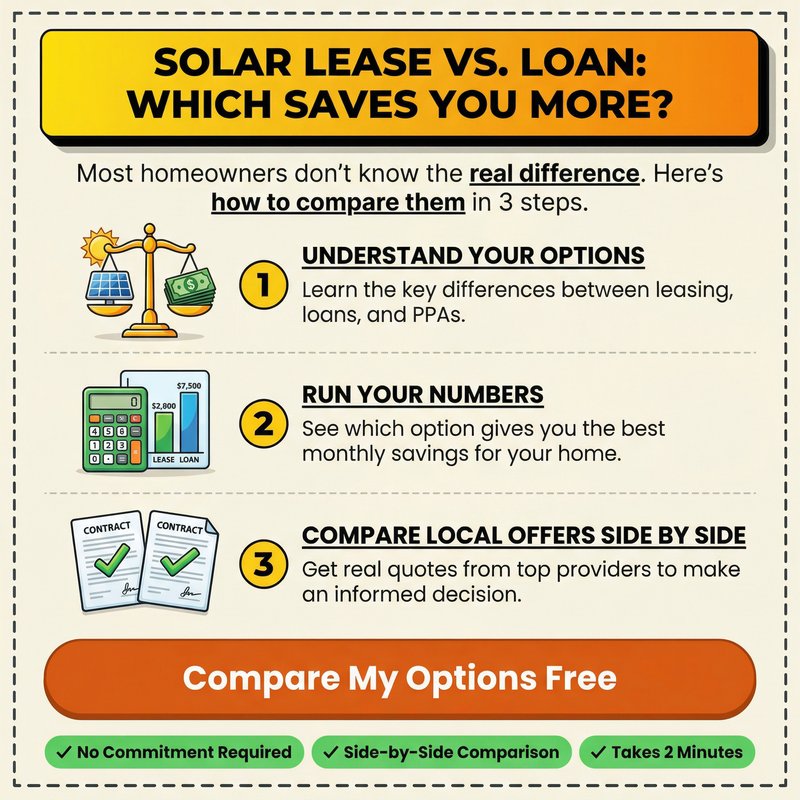
Here’s a rough idea of how savings can stack up:
| Financing Type | Upfront Cost | Monthly Payment | Long-Term Savings (25 Years) |
|---|---|---|---|
| Cash Purchase | High | Low (None) | Highest |
| Solar Loan | Low to Medium | Medium | High |
| Solar Lease | Very Low | Low to Medium | Low to Medium |
| PPA | Very Low | Variable | Low |
Remember, these are general figures. Your actual savings will depend heavily on your specific system, local electricity rates, and the terms of your agreement. Always run the numbers for your own situation.
Actionable Steps for Decision-Making
So, how do you actually pick one? Here’s a plan:
- Check Your Credit and Tax Status: Get your credit report and see what your score is. Also, figure out your tax liability. This is important if you want to claim tax credits.
- Get Multiple Quotes: Don’t just go with the first company you talk to. Get at least three quotes for loans, leases, and PPAs from different providers. Compare the details, not just the price.
- Read the Fine Print: Seriously, read those contracts. Look for things like escalator clauses (where payments go up over time) and what happens if you need to move or want to get out of the deal early.
- Calculate Total Costs: Add up all the payments you’d make over the life of the contract. Compare this total to the estimated savings from the solar energy produced.
- Think About How Long You’ll Stay: If you plan to move in the next five years, a lease might make more sense than taking out a loan. If you’re in it for the long haul, ownership is usually better.
- Talk to Experts: If you’re still unsure, chat with a solar installer who isn’t tied to just one financing option, and maybe even a financial advisor or tax professional.
Maximizing Solar Investments with Incentives
So, you’re thinking about going solar. That’s awesome! But before you sign on the dotted line, let’s talk about how to make that investment work even harder for you. It’s not just about the panels on your roof; it’s also about the smart financial moves you can make. Taking advantage of available incentives can seriously slash the upfront cost of your solar setup.
Leveraging Tax Credits and Rebates
When you buy a solar system, there are often tax credits and rebates available that can make a big difference. Think of them as a thank you from the government for choosing clean energy. The federal solar tax credit, for instance, lets you deduct a percentage of your system’s cost right off your federal taxes. It’s a pretty sweet deal that helps offset that initial investment. Many states and even local municipalities offer their own incentives too, like cash rebates or additional tax credits. It’s definitely worth digging into what’s available in your specific area.
Here’s a quick rundown of what to look for:
- Federal Solar Investment Tax Credit (ITC): This is a big one, allowing you to claim a percentage of your solar system’s cost. Keep an eye on its status, as it can change.
- State Tax Credits: Many states offer their own credits, often stackable with the federal one.
- Local Rebates: Some cities or utility companies provide direct cash rebates.
- Performance-Based Incentives: Less common now, but some programs pay you based on the energy your system produces.
Researching these incentives thoroughly is key. What’s available can change, and understanding the specifics for your location is crucial for maximizing your savings. Don’t leave money on the table!
The Role of Net Metering
Net metering is another important piece of the puzzle. Basically, when your solar panels produce more electricity than your home is using, that excess power gets sent back to the grid. Net metering allows you to get credit on your electricity bill for that exported energy. The exact rules and rates for net metering vary quite a bit from state to state, and even from utility to utility. Some offer a 1:1 credit, meaning you get full retail value for the power you send back, while others might offer a lower wholesale rate. This can significantly impact how quickly your system pays for itself and the overall long-term savings you see. It’s a good idea to check with your local utility provider to understand their specific net metering policy. You can find more details on how net metering works in your area here.
Community Solar Programs as an Alternative
What if your home isn’t suitable for rooftop solar? Maybe you rent, or your roof is shaded or in bad shape. Don’t worry, community solar programs offer a way for almost anyone to benefit from solar energy. Instead of installing panels on your own home, you subscribe to a share of a larger, local solar farm. You then receive credits on your utility bill for the electricity your share of the farm produces. It’s a fantastic option if rooftop installation isn’t feasible. These programs typically offer savings of around 5-15% on your electricity costs without any upfront installation or maintenance on your part. As of 2025, these programs are available in a growing number of states, making solar power more accessible than ever.
Making the Right Solar Choice for You
So, you’ve looked at loans, leases, and maybe even paying cash for solar. It’s a lot to think about, for sure. But the good news is, there are options out there for pretty much everyone. Whether you want to own your system outright and grab all those tax breaks, or you just want to pay a set monthly fee and forget about maintenance, there’s likely a path that fits your wallet and your life. Take your time, compare the numbers, and don’t be afraid to ask questions. Picking the right way to go solar is a big step, but it’s one that can save you money and help the planet for years to come. You got this.
Frequently Asked Questions
What’s the difference between a solar loan, lease, and PPA?
Think of it like this: a solar loan means you buy the solar panels and own them, just like buying a car with a loan. A solar lease is like renting the panels for a set monthly fee. A Power Purchase Agreement (PPA) is similar to a lease, but instead of paying a flat fee, you pay for the electricity the panels produce, usually at a lower rate than your electric company.
If a loan is the route you are leaning towards, see how the Credit Human solar loan works in practice, including rates, terms and eligibility.
Which solar financing option saves the most money in the long run?
Generally, buying your solar panels with a loan or paying cash upfront leads to the biggest savings over time. This is because you own the system and get to keep all the money you save on electricity bills, plus you can take advantage of tax breaks. Leases and PPAs can save you money too, but you’re essentially paying someone else to own the system.
Do I need good credit to get a solar loan?
Having good credit definitely helps you get better interest rates on a solar loan, making it more affordable. Some lenders might require a credit score of 650 or higher. However, there are sometimes options available even if your credit isn’t perfect, though the terms might not be as good.
What are the benefits of leasing solar panels if I don’t own them?
Leasing solar panels is great if you want to go solar without paying a lot of money upfront. It’s like renting, you get the benefit of lower electricity bills and clean energy without the hassle of buying and maintaining the system. The leasing company usually handles all the upkeep and repairs.
Can I still get tax credits if I don’t buy my solar panels outright?
Usually, you can only get federal tax credits and other incentives if you own the solar system. This means if you choose a solar lease or a PPA, the company that owns the panels gets those tax benefits, not you. That’s one of the main reasons why owning a system often leads to greater long-term savings.
What is community solar and how does it work?
Community solar is a fantastic option if you can’t put solar panels on your own roof (maybe you rent, or your roof isn’t suitable). You subscribe to a share of a larger, local solar farm. You then get credits on your electricity bill for the clean energy your share produces, typically saving you money without any installation at your home.
Two pieces go deeper on the rental side of that comparison: what a solar lease actually commits you to and whether a lease or a loan saves more over 25 years.
Ready to Start Saving on Your Energy Bills?
Get a free, no-obligation quote from trusted local providers in under 2 minutes.
No obligation • Free estimates • Takes under 2 minutes
Want real quotes before you decide how to pay for it?
A loan only makes sense once you know what the system will actually cost. If your electric bill runs above $150 a month and your roof gets decent sun, a personalized quote gives you real numbers to put into any loan comparison. Quotes are available nationwide.
Recent Posts
- Pennsylvania electricity supplier complaints: How to document, file, and resolve a billing dispute
- What happens when my electricity contract ends in Pennsylvania? A practical guide
- Pennsylvania electricity early termination fees: what to check before canceling your contract
- Power to Choose in Texas: How to compare electricity plans and rates
- How to read your Texas energy bill: A plain-English guide to every charge and fee