Solar Panel Loan: Compare Terms, APRs & Monthly Payments

Thinking about getting solar panels for your home? That’s awesome. It’s a big step towards saving money and helping the environment. But, let’s be real, those panels aren’t exactly cheap. Most people don’t just have thousands of dollars lying around. That’s where a solar panel loan comes in handy. It lets you get the system installed without paying everything upfront. But, just like any loan, there are different kinds, and you want to make sure you get the best deal possible. We’re going to break down what you need to know about solar panel loans so you can make a smart choice.
Key Takeaways
- A solar panel loan lets you own your solar system without paying the full cost upfront, often making monthly payments similar to or less than your old electricity bill.
- When comparing solar panel loans, look closely at the loan term length, interest rates, and Annual Percentage Rate (APR), which includes fees.
- Secured loans use collateral like your home, potentially offering lower rates but risking the collateral if you don’t pay. Unsecured loans don’t require collateral but can be harder to get and might have higher rates.
- Specialty solar lenders and some government programs offer financing options, each with its own set of terms and benefits.
- Always compare quotes from multiple lenders, read the fine print carefully, and consider the total cost, not just the interest rate, to find the best solar panel loan for your budget.
Understanding Solar Panel Loan Basics
Reviewing Loan Paperwork Alongside A Completed Rooftop Solar Installation.
Thinking about putting solar panels on your roof but don’t have a pile of cash lying around? You’re not alone. Most folks finance their solar setups, and a solar panel loan is a common way to do it. Basically, it’s a loan specifically for buying and installing a solar energy system for your home. Instead of paying a big chunk upfront, you borrow the money and pay it back over time, usually with interest.

What is a Solar Panel Loan?
A solar panel loan is a type of personal loan designed to cover the costs associated with purchasing and installing a solar energy system. This includes the panels themselves, inverters, mounting hardware, and the labour to put it all in. The idea is to make going solar more accessible by spreading the cost out over several years, making it fit into your monthly budget.
Key Features of Solar Loans
Solar loans can have a few different characteristics you’ll want to get familiar with. They aren’t all the same, so knowing these details helps when you’re comparing your options.
- Loan Term Length: This is how long you have to pay the loan back, typically ranging from 5 to 25 years. A longer term means lower monthly payments, but you’ll likely pay more interest overall. A shorter term means higher monthly payments but less interest paid over the life of the loan.
- Interest Rate vs. APR: The interest rate is the cost of borrowing money. The Annual Percentage Rate (APR) is similar but also includes certain fees associated with the loan, giving you a more complete picture of the total cost of borrowing.
- Secured vs. Unsecured: Most solar loans are unsecured, meaning they aren’t backed by collateral like your house. This can make them easier to get but sometimes means a slightly higher interest rate. Secured loans might have lower rates but put an asset at risk if you can’t make payments.
- Dealer Fees: Sometimes, the company installing your solar panels might add fees to the loan. These can increase the total amount you borrow and pay interest on, so it’s important to know if they’re included.
Benefits of Financing Solar Panels
Why bother with a loan instead of saving up? Well, there are some pretty good reasons.
- Immediate Savings: You can start generating your own electricity and potentially lower your monthly utility bills right away, even while you’re paying off the loan. Sometimes, the savings on your electricity bill can be more than your loan payment.
- Ownership and Incentives: When you own your solar panels (which you do with a loan), you can claim tax credits and other incentives that can significantly reduce your overall cost. Leased systems don’t usually offer this benefit.
- Budget Predictability: A fixed monthly loan payment can be easier to budget for than fluctuating electricity bills, especially with rising energy costs.
Going solar with a loan means you own the system from day one. This ownership is key to taking advantage of things like federal tax credits, which can really cut down on the total expense. Plus, you get to enjoy the benefits of generating your own clean energy without having to pay for the whole system upfront. It’s a way to make a big investment more manageable for your household budget.
Comparing Solar Panel Loan Terms and Rates
When you’re looking into financing for solar panels, it’s easy to get lost in all the numbers. But understanding the loan terms and rates is super important for making sure you get a good deal that fits your budget. It’s not just about the sticker price of the panels; it’s about the long game of paying for them.
Loan Term Lengths Explained
The loan term is simply how long you have to pay back the money you borrowed. Solar loans can range quite a bit, often from 5 years all the way up to 25 years. Think of it like this: a shorter term means bigger monthly payments, but you’ll be debt-free sooner and likely pay less interest overall. A longer term means smaller monthly payments, which can be easier on your wallet month-to-month, but you’ll probably end up paying more interest over the life of the loan.
- Shorter Terms (e.g., 5-15 years): Higher monthly payments, less total interest paid, faster ownership.
- Medium Terms (e.g., 15-20 years): A balance between monthly payment size and total interest.
- Longer Terms (e.g., 20-25 years): Lower monthly payments, more total interest paid, potentially matching energy savings.
It’s a trade-off, really. You want to find a term where the monthly payment is manageable and ideally close to what you’ll save on electricity bills, so you’re not feeling the pinch.
Interest Rates vs. APRs for Solar Loans
This is where things can get a little tricky, and it’s good to know the difference. The interest rate is the basic cost of borrowing money, expressed as a percentage. The Annual Percentage Rate (APR), however, gives you a more complete picture. It includes the interest rate plus any fees associated with the loan, like origination fees or dealer fees. So, while two loans might have the same interest rate, the one with higher fees will have a higher APR, meaning it’s actually more expensive.
Always look at the APR when comparing loans. It’s the true cost of borrowing.
Here’s a general idea of what you might see, though rates change:
| Loan Type | Typical Interest Rate Range | Typical APR Range (including fees) |
|---|---|---|
| Unsecured Solar | 2.99% – 5.99% | 3% – 7% |
| Secured Solar | 5% – 8% | 5% – 8% |
Note: These are general ranges and can vary significantly based on your credit, the lender, and market conditions.
Understanding Dealer Fees and Other Costs
Dealer fees, sometimes called origination fees or finance charges, are a big one to watch out for. These are fees charged by the lender or the installer for setting up the loan. They can sometimes be a percentage of the total loan amount, and they can significantly increase the overall cost of your loan, even if the advertised interest rate looks low. Some lenders might advertise a low interest rate but then tack on a hefty dealer fee, which gets rolled into the loan principal. This means you’re paying interest on that fee too!
Always ask for a full breakdown of all fees before signing anything. Don’t be afraid to question charges that don’t make sense. Sometimes, installers have preferred lenders, and they might get a kickback, which can be passed on to you as a higher fee.
It’s really about looking beyond just the interest rate. A loan with a slightly higher interest rate but no dealer fees might be a better deal than one with a super low rate but a big fee. Reading the fine print and asking lots of questions is your best bet here.
Types of Solar Panel Loans Available
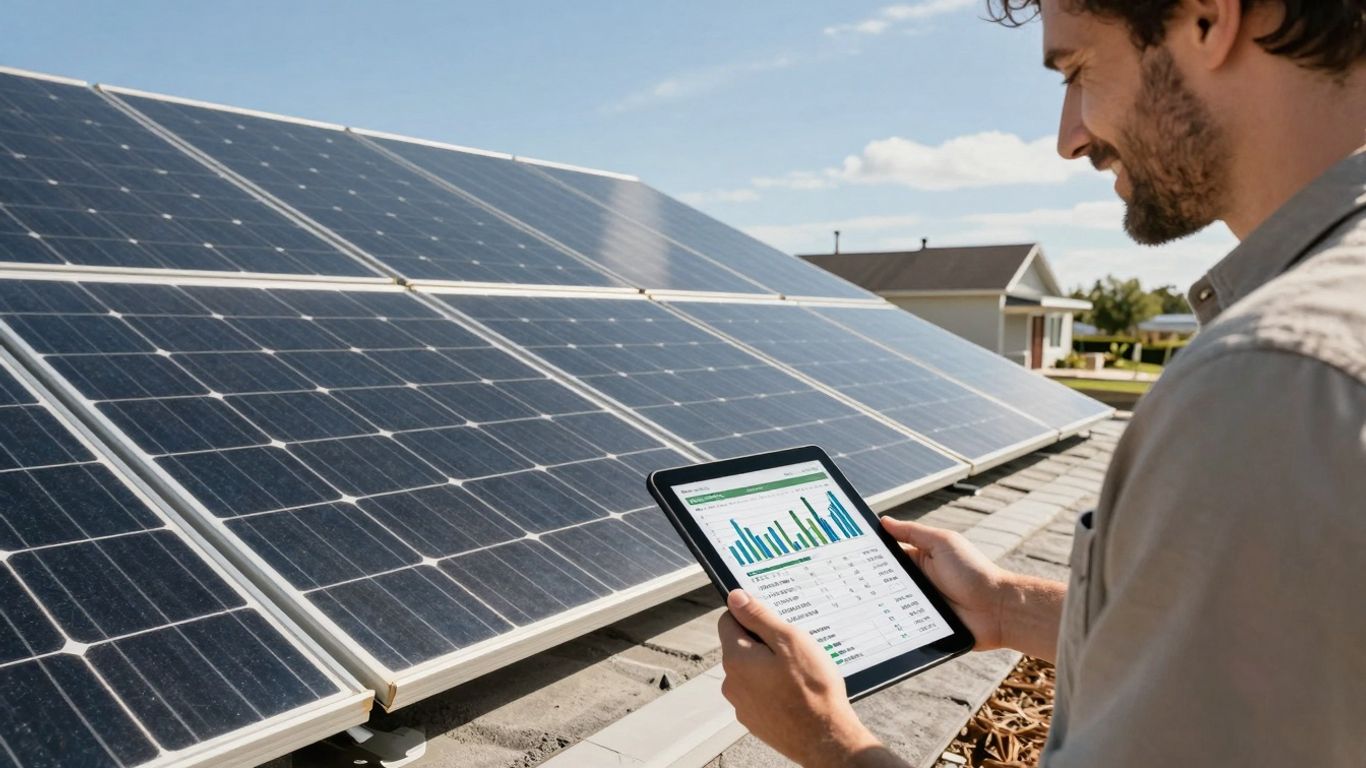
A Homeowner Reviews Solar Performance Data During A Rooftop Installation
When you’re looking into financing solar panels, you’ll find there are a few different ways loans are structured. It’s not just one-size-fits-all, which is good because it means you can find something that fits your situation better. The main ways to categorize these loans are whether they’re secured or unsecured, and if they come from specialty lenders or government programs.
Secured vs. Unsecured Solar Loans
This is a big one. A secured loan means you’re putting something up as collateral. For solar loans, this usually means the solar panel system itself, or sometimes your home. The upside here is that because the lender has something to fall back on if you can’t pay, they often offer lower interest rates. The downside? If you miss payments, they can take the panels or even foreclose on your home. An unsecured loan, on the other hand, doesn’t require collateral. The lender looks at your credit history, income, and other financial factors to decide if they’ll approve you. These can be a bit harder to get approved for, and the interest rates might be a little higher to make up for the added risk for the lender. Most solar-specific loans tend to be unsecured, which is often preferred by homeowners.
Specialty Solar Lenders
These are companies that focus specifically on financing solar energy projects. They often work closely with solar installers, so the loan process can feel pretty integrated with buying and installing your system. You might get a loan offer right on the spot when you’re talking to the sales rep. These lenders understand the solar industry well, so their loan products are often tailored to things like the lifespan of solar equipment and potential incentives. Some big names in this space have partnered with banks to offer these loans nationwide. They can be a convenient option, especially if your installer recommends one.
Government-Backed Solar Financing Options
Beyond private lenders, there are also programs backed by the government that can help finance solar. These often come with benefits like lower interest rates because they’re subsidized by taxpayer money. Examples include programs through the Federal Housing Administration (FHA) that can add the cost of solar to your mortgage, or specific energy-efficient mortgage programs. While these might not always be as straightforward as a dedicated solar loan from a private company, they can offer significant savings if you qualify. It’s worth checking if any federal or state programs are available in your area, as they can sometimes provide a more affordable route to going solar.
Navigating Solar Panel Loan Providers
So, you’ve decided to go solar, which is awesome! Now comes the part where you figure out who’s going to lend you the money. It can feel like a lot, with so many companies out there, but breaking it down makes it way easier. The key is to shop around and not just go with the first option you see.
Ready to take the next step? solar panel loan terms and see your personalized options.
Top Solar Loan Providers
Lots of companies offer solar loans, and some are more popular than others. Installers often work with specific lenders, so you might get a loan offer right when you’re talking about panels. Some of the big names you might hear about include Mosaic, Sunlight Financial, and Good Leap. But don’t stop there! There are also credit unions and even some government programs that can help. It’s a pretty fragmented market, meaning no single company dominates everything, which is good news for you because it means more choices.
Here’s a quick look at some providers and what they’ve offered, though remember rates change:
| Provider | Average Interest Rate (Approx.) | Term Length (Years) |
|---|---|---|
| Mosaic | 5.68% | 20 |
| Sunlight Financial | 5.23% | 20 |
| Good Leap | 3.95% | 25 |
| Dividend Finance | 5.61% | 20 |
| Energy Loan Network | 5.24% | 15 |
| Clean Energy Credit Union | 7.00% | 15 |
How to Choose the Right Lender
When you’re comparing lenders, don’t just look at the interest rate. That’s like buying a car and only looking at the sticker price without checking the gas mileage. You need to consider the whole picture.
- Interest Rate vs. APR: The Annual Percentage Rate (APR) gives you a better idea of the total cost because it includes fees. A low interest rate might look good, but if the APR is high due to fees, it’s not such a great deal.
- Loan Term: How long you have to pay it back affects your monthly payment. Longer terms mean lower monthly payments, but you’ll pay more interest over time. Shorter terms mean higher monthly payments but less interest overall.
- Fees: Watch out for origination fees, dealer fees, or other charges that get rolled into your loan. These can add up quickly. Always ask what fees are included.
- Secured vs. Unsecured: Most solar loans are unsecured, meaning your home isn’t directly on the line if you default. However, it’s always good to know the specifics of the loan agreement.
Before you sign anything, it’s wise to get quotes from several different places. This helps you see the range of options and terms available. Don’t feel pressured to sign on the spot; take your time to review everything carefully.
Comparing Loan Quotes Effectively
Getting multiple quotes is smart, but you need to compare them apples-to-apples. Here’s how:
- List All Costs: Write down the loan amount, interest rate, APR, all fees, and the total repayment amount for each quote.
- Calculate Monthly Payments: See what your monthly payment would be for each loan option.
- Consider the Total Interest Paid: Over the life of the loan, how much interest will you end up paying.
Talking to a trusted financial advisor or even a knowledgeable solar installer can also help you make sense of all the numbers and choose the loan that best fits your financial situation and long-term goals.
Making Informed Solar Panel Loan Decisions
So, you’ve looked at the different types of solar loans and compared rates and terms. Now comes the part where you really need to think about what works for your wallet and your home. It’s not just about getting the panels on your roof; it’s about making sure the financing makes sense long-term.
Evaluating Monthly Payments
This is probably the most obvious thing to look at. You need to figure out what your monthly payment will be and, more importantly, if you can comfortably afford it. Don’t just look at the number the salesperson gives you. Break it down. What’s the actual principal amount you’re borrowing? What’s the interest rate? Are there any fees baked into that monthly payment? Sometimes, a low monthly payment might look good, but it could mean a longer loan term or a higher interest rate over time. It’s a good idea to see if your projected monthly savings on electricity bills will actually cover, or even beat, your new loan payment. Ideally, your solar loan payment should be less than or equal to what you were paying for electricity before.
The Impact of Loan Terms on Your Budget
Loan terms aren’t just numbers on a contract; they directly affect your budget for years to come. A shorter loan term means higher monthly payments but less interest paid overall. A longer term means lower monthly payments, which might be easier on your budget right now, but you’ll end up paying more interest in the long run. Think about your financial goals. Are you planning to move in the next 10 years? A shorter term might be better. Or are you looking to stay put and maximize savings over 25 years? A longer term could work. It’s a balancing act between immediate affordability and total cost.
Here’s a quick look at how different terms can affect the total interest paid (assuming a R30,000 loan at 6% APR):
| Loan Term (Years) | Monthly Payment (Approx.) | Total Interest Paid (Approx.) |
|---|---|---|
| 10 | R333.27 | R9,990.40 |
| 15 | R250.07 | R15,012.60 |
| 20 | R213.31 | R21,194.40 |
| 25 | R193.33 | R27,999.00 |
Maximizing Your Solar Investment
Getting a solar loan is just the first step in making solar panels a good investment. You want to make sure the system itself is high quality and installed correctly. Also, remember those government incentives, like the federal solar tax credit. While it’s often presented as a direct discount, it’s actually a credit on your taxes. This means you need to have enough tax liability to claim it. Some loan agreements might try to “bake in” the expected tax credit, which can sometimes hide the true cost of the loan. Always understand the full price of the system and the loan before any tax credits are factored in.
Be wary of “dealer fees” or “origination fees” that can significantly increase the total amount you borrow. These fees are sometimes hidden within the loan principal and can add a substantial percentage to the cost of your solar system. Always ask for a clear breakdown of all costs involved.
It’s really important to shop around and get multiple quotes. Don’t just go with the first company that knocks on your door. Compare loan terms, interest rates, APRs, and especially those fees. Talking to a few different lenders, including maybe your local credit union, can give you a much clearer picture of what’s available and help you find the best deal for your situation.
Wrapping It Up
So, you’ve looked at the different ways to finance solar panels, and it’s clear there are options out there. Whether you’re eyeing a loan with a short term or a longer one, remember to check the interest rates, any extra fees, and how long you’ll be paying it off. It’s not just about the lowest number you see at first glance. Taking the time to compare what different lenders offer can really make a difference in your wallet over the years. Think about what fits your budget best, and don’t be afraid to ask questions until you feel good about the choice you’re making for your home’s solar future.
Frequently Asked Questions
What exactly is a solar panel loan?
Think of a solar panel loan like any other loan you might get to buy something big, like a car. It’s a sum of money you borrow specifically to pay for solar panels and their installation on your home. You pay this money back over time, usually with a little extra added on as interest.
Do I get to keep my solar panels if I get a loan?
Yes, that’s one of the big pluses! Unlike leasing, when you get a solar loan, you legally own the solar panels from the start. This means you can take advantage of special government programs and tax breaks that can save you money.
What’s the difference between an interest rate and an APR?
An interest rate is just the basic cost of borrowing money. The APR, or Annual Percentage Rate, is a bit more complete. It includes the interest rate plus any extra fees the lender charges. So, the APR gives you a clearer picture of the total yearly cost of your loan.
Are there different kinds of solar loans?
You bet! Some loans are ‘secured,’ meaning they use something like your home or the panels themselves as a guarantee for the lender. Others are ‘unsecured,’ which means they don’t have collateral but might be harder to get. There are also loans from special solar companies, regular banks, and even government programs.
How long do I have to pay back a solar loan?
Loan terms can vary quite a bit. Many solar loans are for 15 to 20 years, but you can sometimes find them for up to 25 years. The idea is often to match your monthly loan payment with the amount you expect to save on electricity each month.
Is it better to get a loan from a solar installer or a bank?
It’s smart to shop around! Solar installers often have special loan programs that can be convenient. However, banks and credit unions might offer different rates and terms. Comparing offers from at least three different places is a really good idea to find the best deal for you.
Ready to Start Saving on Your Energy Bills?
Get a free, no-obligation quote from trusted local providers in under 2 minutes.
No obligation • Free estimates • Takes under 2 minutes
Recent Comments
Recent Posts
- Essential Factors to Consider Before Hiring an Energy Broker: Power to Choose is Choose My Power
- How to Choose a Power Company and a Broker: Power to Choos is Choose My Power
- How Does Choosing the Right Energy Broker Can Help You Save Money
- Commercial Solar Financing: Best Options for Businesses (Loans, PPAs, Leases)
- Solar Financing Near Me: How to Find Local Lenders & the Best Deals