Solar Loan Interest Rates: What Impacts Your APR (and How to Lower It)

See What a Loan on Your Home Would Actually Look Like
Your credit, loan term, and system size all move your APR. A local quote gives a real system cost so a lender can quote you an actual rate, not a range.
Disclosure: we may earn a commission if you switch or request a quote through this link, at no extra cost to you. It never changes which plan or company we recommend. How we make money.
Thinking about getting solar panels for your home? That’s great! But before you sign on the dotted line, let’s talk about the money part. Specifically, the interest rates on solar loans. It can seem a bit confusing with all the numbers and terms, but understanding what affects your solar loan interest rates and how you might get a better deal is super important. We’ll break down what APR really means, why some loans have fees that change the game, and how you can end up with a loan that saves you money in the long run.
Key Takeaways
- The Annual Percentage Rate (APR) gives you a clearer picture of your loan’s total cost than just the interest rate alone, because it includes fees.
- Loans with lower fees and slightly higher interest rates can sometimes be a better deal overall than loans with very low interest but high fees, especially since solar loan fees can’t be refinanced.
- Your credit score is a big deal when it comes to getting good solar loan interest rates; a better score usually means a lower rate.
- Shopping around and comparing offers from different lenders is one of the best ways to find lower solar loan interest rates.
- While interest rates have gone up recently, understanding the different types of solar loans and their associated fees can still help you find a financing option that works for your budget.
Understanding Solar Loan Interest Rates
The Role of Annual Percentage Rate (APR)
When you’re looking at loans for solar panels, you’ll see a lot of talk about interest rates. But here’s a little secret: the interest rate isn’t the whole story. What you really need to pay attention to is the Annual Percentage Rate, or APR. Think of APR as the total cost of borrowing money, all rolled into one number. It includes not just the interest you’ll pay over the life of the loan, but also any fees that come with it. So, a loan with a seemingly low interest rate might actually end up costing you more if it has a bunch of hidden fees. It’s the APR that gives you the clearest picture of what you’ll actually pay.
Interest Rates Versus Fees: A Crucial Distinction
This is where things can get a bit tricky with solar loans. Sometimes, lenders offer a loan with a really low interest rate, which sounds great, right? But then they tack on what are called “dealer fees.” These fees can be pretty substantial, and they’re often built into the loan amount. This means you’re paying interest on those fees too, which can really add up over time. On the flip side, you might see a loan with a higher interest rate but very few, or even no, fees. It sounds counterintuitive, but sometimes that higher-interest, low-fee loan can actually be cheaper in the long run because you’re not paying interest on a big chunk of fees.
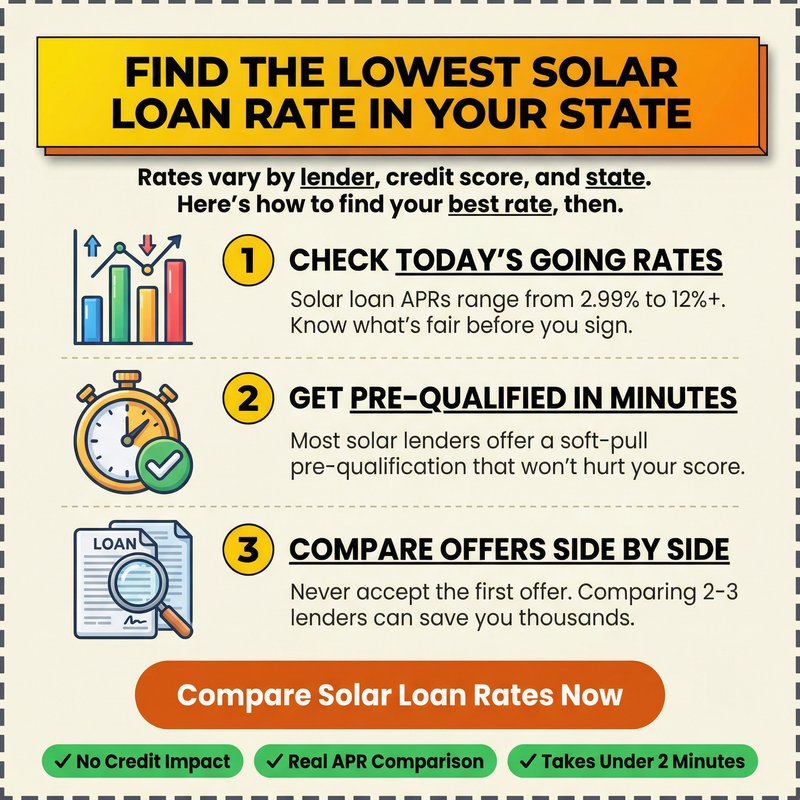
Here’s a quick way to think about it:
- Low Interest Rate + High Fees: Might look good at first, but fees inflate the total cost.
- High Interest Rate + Low Fees: Can be more affordable overall because the total borrowed amount is lower.
Current Trends in Solar Loan Interest Rates
Things have changed a bit in the solar loan market lately. A few years ago, you might have found loans with super low interest rates. But with changes in the economy, interest rates in general have gone up, and that includes solar loans. In the latter half of 2024, for example, the most common interest rate you’d see quoted was around 8.49%, often for a 20-year loan. It’s not uncommon to see rates in the 6% and higher range now. What’s interesting, though, is that while interest rates have climbed, there’s been a growing trend towards loans with lower fees. This shift means that even with higher interest rates, the overall cost of some loans might be more manageable than they were when high fees were common, even with lower advertised rates.
The solar loan landscape is evolving. While low interest rates are always appealing, it’s the APR that truly tells the story of your loan’s total cost. Understanding the interplay between interest rates and fees is key to making a smart financial decision for your solar investment.
Factors Influencing Your Solar Loan Interest Rate
So, you’re looking into solar loans and wondering why some people get better rates than others. It’s not just random chance; a few key things play a big part in what interest rate you’ll be offered. Understanding these can really help you get a better deal.
The Impact of Your Credit Score
This is probably the biggest one. Lenders look at your credit score like a report card for how you handle money. A higher score shows you’re a reliable borrower, meaning you’re less likely to miss payments. Because of this, lenders feel more comfortable offering you a lower interest rate. Think of it this way: if you have a history of paying bills on time and managing debt well, a bank sees you as a safer bet. Someone with a lower score might have missed payments or carried high balances, making them a riskier borrower. That risk comes with a higher price tag, a higher interest rate.
- Excellent Credit (740+): You’ll likely qualify for the lowest rates available.
- Good Credit (670-739): You’ll probably get competitive rates, but maybe not the absolute best.
- Fair Credit (580-669): Expect higher rates, as lenders see more risk.
- Poor Credit (Below 580): Getting approved might be tough, and rates will be significantly higher, if available at all.
Your credit score isn’t just a number; it’s a direct reflection of your financial habits. A good score can save you thousands over the life of a loan, while a poor one can make the entire project much more expensive, or even unattainable.
The Significance of Loan Term Length
When you take out a solar loan, you’ll have to decide how long you want to take to pay it back. That’s the loan term. Generally, longer loan terms mean lower monthly payments. That sounds good, right? But here’s the catch: over a longer period, you’ll end up paying more in total interest. Lenders often charge a slightly higher interest rate for longer terms because there’s more time for things to go wrong, and more interest for them to collect. Shorter terms usually come with lower interest rates but higher monthly payments. It’s a trade-off between immediate affordability and long-term cost.
| Loan Term | Typical Interest Rate Impact | Monthly Payment | Total Interest Paid |
|---|---|---|---|
| 5 Years | Lower | Higher | Lower |
| 10 Years | Medium | Medium | Medium |
| 20 Years | Higher | Lower | Higher |
How Lender Strategies Affect Rates
Different companies have different ways of doing business, and this really shows up in their loan products. Some lenders focus on offering very low interest rates but then load up the loan with fees. Others might have slightly higher interest rates but keep the fees really low. It’s important to look at the Annual Percentage Rate (APR), which includes both the interest rate and all the fees, to get the real cost of the loan. Sometimes, a loan with a higher interest rate but minimal fees can actually be cheaper overall than one with a super low interest rate but hefty upfront charges. The market is shifting, and you’re seeing more companies offer low-fee, higher-interest loans because they can be more flexible for homeowners, especially if you plan to pay the loan off early or refinance later. It really pays to compare not just the interest rate, but the entire package.
Strategies for Securing Lower Solar Loan Interest Rates
So, you’ve decided to go solar, which is awesome! Now comes the part where you figure out how to pay for it without breaking the bank. Getting a good interest rate on your solar loan can make a big difference in your monthly payments and how much you save over time. It’s not just about finding any loan; it’s about finding the right loan for you.
The Power of Shopping Around for Quotes
Seriously, don’t just take the first offer that comes your way. It’s like buying a car. You wouldn’t buy the first one you see, right? The same goes for solar loans. Different lenders have different rates and fees, and some are way better than others. Take some time to get quotes from a few different places. Most lenders will give you a free quote that’s good for a little while, giving you time to compare.
- Make a list of potential lenders. This could include banks, credit unions, and specialized solar loan companies.
- Gather your financial information beforehand. This will speed up the quote process.
- Compare not just the interest rate, but the APR. Remember, APR includes fees, which can really add up.
Leveraging a Co-signer for Better Terms
If your credit isn’t stellar, or even if it is, bringing in a co-signer can really help. A co-signer is someone who agrees to be responsible for the loan if you can’t make payments. Having a co-signer with a strong credit history can often get you a lower interest rate. It shows the lender that there’s less risk involved, and they’re usually happy to offer better terms because of that.
Improving Your Creditworthiness Before Applying
Your credit score is a big deal when it comes to loan rates. A higher score generally means a lower interest rate. If you have a little time before you need the loan, focus on boosting your credit score. Even small improvements can save you a good chunk of change over the life of the loan.
- Pay down existing debt: Focus on credit card balances and any outstanding loans. Lowering your credit utilization ratio is key.
- Make all payments on time: This is the most basic, yet most important, factor in your credit score.
- Check your credit report for errors: Sometimes, mistakes on your report can unfairly lower your score. Dispute any inaccuracies you find.
It’s easy to get caught up in just the interest rate, but remember to look at the whole picture. Sometimes a loan with a slightly higher interest rate but very low fees can end up costing you less overall than a loan with a super low rate but hefty hidden charges. Always ask about all the fees involved and what they cover.
The Nuances of Solar Loan Fees
Understanding Dealer Fees and Their Impact
When you’re looking at solar loans, you’ll notice something called a “dealer fee” or “finance charge.” This isn’t like a typical loan fee you might see elsewhere. Basically, the company that installs your solar panels works with a lender, and they build this fee into the loan. It can be a pretty big chunk, sometimes 20% to 40% of the total system cost. This fee gets added to the amount you borrow, meaning you’re paying interest on it too.
The main reason these fees exist is to allow the lender to offer a seemingly lower interest rate on the loan itself. It’s a way for them to make their money back and then some, while keeping your monthly payments looking more manageable. Think of it as a trade-off: a lower advertised interest rate in exchange for a higher overall loan amount due to these upfront fees.
Why Low-Fee Loans Can Be Advantageous
While dealer fees are common, they can really add up. A loan with a lower interest rate but a hefty dealer fee might end up costing you more in the long run than a loan with a slightly higher interest rate but minimal or no dealer fees. This is because you’re paying interest on that dealer fee for the entire life of the loan. Loans with lower fees, even if the interest rate is a bit higher, can sometimes be more cost-effective over the 15, 20, or even 25 years you’ll be paying it off. It’s all about looking at the total cost, not just the monthly payment or the advertised APR.
Ready to take the next step? lower your solar APR and see your personalized options.
The Inability to Refinance Dealer Fees
Here’s a tricky part about dealer fees: unlike the interest portion of your loan, you generally can’t get rid of them by refinancing or paying the loan off early. If you decide to refinance your solar loan down the road to get a better rate, the original dealer fee is usually baked into the principal and stays there. Similarly, if you want to pay off your loan ahead of schedule, you’re still paying interest on that initial fee. This makes it really important to understand the full cost of the loan upfront, including all fees, before you sign anything. It’s a one-time charge that impacts your loan for its entire duration.
Navigating the Solar Loan Market
Digital Comparison Of Solar Financing Rates.
The world of solar loans can feel a bit like a maze sometimes, with different companies and terms popping up everywhere. It’s not always straightforward, and understanding where to find the best deal is key. You’ve got your big national lenders, local credit unions, and even financing options directly from the solar installer themselves. Each has its own way of doing things, which means different rates and fees.
To see how one of those compares in practice, our review sets out a credit union’s published solar APR ranges and what moves them.
The Rise of Low-Fee, High-Interest Loans
Lately, there’s been a trend where some lenders offer loans with very few upfront fees. Sounds great, right? But often, this means the interest rate you pay over the life of the loan is higher. It’s like getting a free appetizer but paying more for the main course. You need to look at the total cost, not just the initial price tag. For example, a loan with no origination fee might have an APR that’s a full percentage point higher than one with a small fee. Over 20 years, that difference adds up.
The Importance of Transparency in Financing
This is where things can get tricky. Not all loan agreements are laid out clearly. Some might bury extra charges or make it hard to figure out the true cost of borrowing. Always ask for a full breakdown of all fees and understand exactly what your Annual Percentage Rate (APR) includes. This means looking beyond just the interest rate to see things like origination fees, processing fees, and any other charges. If a lender seems hesitant to provide this information or makes it confusing, it’s a red flag.
Projected Interest Rate Outlook for Solar Loans
Predicting interest rates is always a bit of a guessing game, but generally, they tend to follow broader economic trends. If the Federal Reserve raises its key interest rates, you’ll likely see solar loan rates go up too. Conversely, if rates go down, solar loans might become cheaper. It’s also worth noting that the market is always evolving. New lenders enter, and existing ones adjust their strategies. Staying informed about general economic conditions and keeping an eye on the solar financing landscape can help you time your loan application for potentially better terms.
Maximizing Savings with Your Solar Loan
Using Real-Time Apr Data To Calculate Monthly Savings And Total Loan Costs In The 2026 Market.
Aligning Loan Payments with Energy Savings
So, you’ve got your solar panels, and you’ve got a loan to pay for them. The real trick now is making sure this whole setup actually saves you money, not just costs you more in the long run. The sweet spot is when your monthly loan payment is less than or equal to what you’re saving on your electricity bill each month. If you can hit that mark, you’re basically cash-flow positive from day one. It feels pretty good to have your system paying for itself right out of the gate. But, you gotta watch out. Some companies try to make it look like you’re saving a ton by inflating the system price and then setting the loan payment just below your old bill. It’s like a magic trick, but not the good kind. Always check the numbers to make sure the system price is fair, not just the loan payment.
The Benefits of Early Loan Payoff
Paying off your solar loan faster than scheduled can really cut down on the total interest you end up paying. Think of it like this: the less time the lender has your money, the less interest they can charge you. Even small extra payments can make a difference over the life of the loan. Some loans have prepayment penalties, so it’s important to know if yours does before you start sending in extra cash. If there are no penalties, though, putting a little extra towards the principal whenever you can is a smart move. It’s like giving yourself a discount on the whole project.
Considering Loan Term Length for Long-Term Value
When you’re looking at solar loans, the length of the loan term is a big deal. A shorter term means higher monthly payments, but you’ll pay less interest overall. A longer term means lower monthly payments, which might be easier on your budget right now, but you’ll end up paying more interest over time. It’s a trade-off. You need to figure out what works best for your financial situation. Do you want lower monthly bills now, or do you want to save more money in the long run? It’s not always an easy decision, and it depends on your personal finances and how long you plan to stay in your home.
Here’s a quick look at how loan term can affect your total cost:
| Loan Term (Years) | Estimated Total Interest Paid* |
|---|---|
| 5 | $1,500 |
| 10 | $3,200 |
| 15 | $5,100 |
*These are hypothetical examples and actual interest paid will vary based on APR and loan amount.
Choosing the right loan term is about balancing immediate affordability with long-term savings. Don’t just pick the lowest monthly payment without considering the total interest you’ll be paying over the years. It’s a decision that impacts your finances for a long time.
Wrapping It Up: Your Solar Loan Journey
So, we’ve talked a lot about solar loan interest rates and what goes into them. It’s not just about the number you see first; APR gives you the real picture by including all those fees. Remember, a loan with a slightly higher interest rate but fewer fees might actually save you money in the long run, especially since you’ll likely pay off your loan faster than the full term. Keep an eye on those dealer fees. They’re a sunk cost you can’t get back. Always shop around, compare offers from different lenders, and check your credit score. A little effort upfront can make a big difference in your overall savings. Getting solar is a big step, and understanding your loan is key to making it a smart financial move for your home.
Frequently Asked Questions
What exactly is an APR for a solar loan?
APR stands for Annual Percentage Rate. Think of it as the total cost of borrowing money for your solar panels. It includes not just the interest you pay, but also any fees or extra charges. So, while the interest rate tells you how much extra you pay for the money itself, the APR gives you a clearer picture of the loan’s true cost over time.
Are solar loans with high interest rates always a bad deal?
Not necessarily! Sometimes, loans with a slightly higher interest rate might have much lower fees. These ‘low-fee, high-interest’ loans can actually end up costing you less in the long run than a ‘low-interest, high-fee’ loan. This is because those fees can be tricky and you can’t get them back, even if you pay the loan off early.
What’s the biggest factor that affects my solar loan interest rate?
Your credit score plays a huge role. Lenders see a good credit score as a sign that you’re reliable with money. The better your score, the less risky you appear to them, and the more likely they are to offer you a lower interest rate. It’s worth checking your credit and making any improvements before you apply.
How does the length of the loan term change things?
When you choose a longer loan term, your monthly payments will likely be smaller, which can make them easier to manage. However, over the entire life of the loan, you’ll probably end up paying more in interest. A shorter term means higher monthly payments, but you’ll pay less interest overall and own your solar system sooner.
Is it really worth shopping around for solar loan offers?
Absolutely! Just like you wouldn’t buy the first car you see, don’t take the first solar loan offer you get. Different lenders have different rates and fees. By getting quotes from several companies, you can compare them and find the one that offers you the best deal, potentially saving you thousands of dollars.
Can I pay off my solar loan early, and does it save me money?
Yes, you can usually pay off your solar loan early. If you do this, you’ll save money on interest because you won’t be paying interest for the full loan period. However, remember those tricky ‘dealer fees’ we talked about? You can’t get those back, even if you pay the loan off super fast. That’s another reason why low-fee loans are often a better choice.
Rate mechanics are easier to judge next to real numbers: what solar loan rates to expect and typical solar panel loan rates compared.
Ready to Start Saving on Your Energy Bills?
Get a free, no-obligation quote from trusted local providers in under 2 minutes.
No obligation • Free estimates • Takes under 2 minutes
Want real quotes before you decide how to pay for it?
A loan only makes sense once you know what the system will actually cost. If your electric bill runs above $150 a month and your roof gets decent sun, a personalized quote gives you real numbers to put into any loan comparison. Quotes are available nationwide.
Recent Posts
- Pennsylvania electricity supplier complaints: How to document, file, and resolve a billing dispute
- What happens when my electricity contract ends in Pennsylvania? A practical guide
- Pennsylvania electricity early termination fees: what to check before canceling your contract
- Cost of electricity in Houston: what your rate and electric bill really include
- How to Compare Electricity Plans Without Picking the Wrong One