Solar Loan Near Me: Local Banks, Credit Unions & Online Lenders Compared
Get a Number to Compare Against Any Lender
Banks, credit unions, and online lenders all quote loans differently, but they all need a system price first. A local quote gives you that number to shop with.
Disclosure: we may earn a commission if you switch or request a quote through this link, at no extra cost to you. It never changes which plan or company we recommend. How we make money.
Thinking about going solar? That’s awesome. It’s a big step, and figuring out how to pay for it can feel a bit overwhelming. You’ve got options, from your local credit union to online companies. We’re going to break down what you need to know about getting a solar loan near you, so you can find the best deal for your home. Let’s get this sorted.
Before you start ringing round, it helps to have a benchmark. Our review sets out one national credit union’s solar loan rates and membership rules.
Key Takeaways
- When looking for a solar loan near me, credit unions often have the lowest rates because they’re member-focused. Online lenders are faster but usually cost more.
- Your credit score is a big deal. A higher score means a lower interest rate, saving you money over time. Aim for at least 680.
- Don’t just take the first offer. Shop around with different lenders, maybe 3 to 5, within a short time frame to see who gives you the best rate.
- Consider options like home equity loans or state programs if they offer better rates than a standard solar loan. Sometimes these can be cheaper.
- Rates can change. While current rates are competitive, watch for trends. The federal solar tax credit is also a factor, so understand how it works with your loan.
Comparing Solar Loan Near Me Options
When you’re looking for a solar loan, it’s not a one-size-fits-all situation. Different places offer different deals, and what works best for one person might not be the right fit for another. You’ve got credit unions, online lenders, the companies that install your solar panels, and even your regular banks. Each has its own way of doing things, especially when it comes to interest rates and how easy it is to get approved.
Credit Union Solar Loan Rates
Credit unions are often a good place to start. Because they’re not-for-profit and member-focused, they tend to offer pretty competitive rates. You might find rates that are a bit lower than what you’d see at a big bank. The catch? You usually have to be a member, and they might not be everywhere you look. But if you’re already a member or can easily join, it’s worth checking out. Some credit unions might offer rates in the 6-8% APR range, sometimes even lower for folks with great credit.
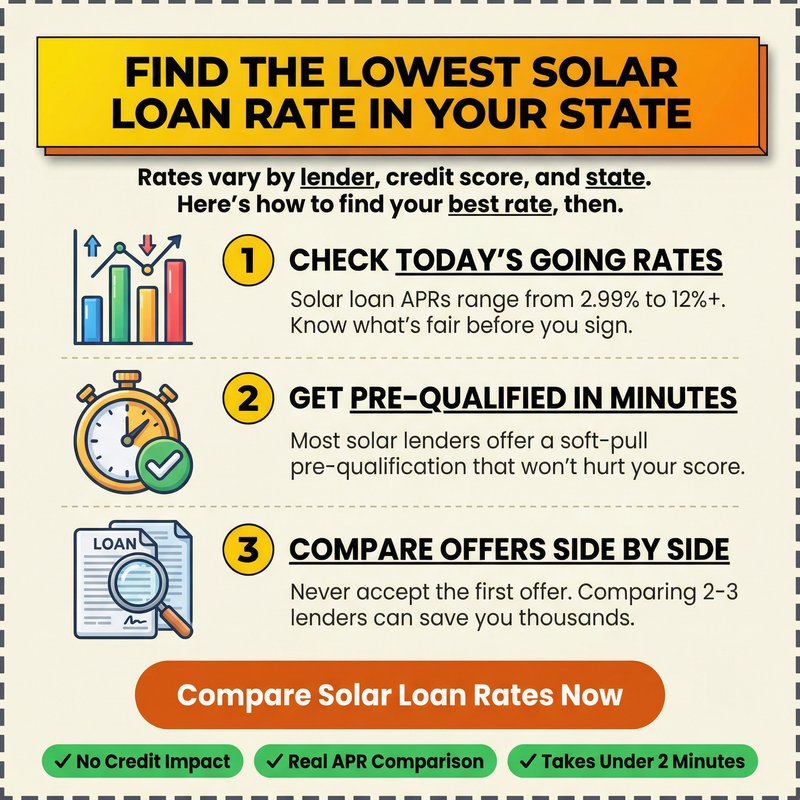
Top Online Lender Offers
Online lenders are all about speed and convenience. You can often apply and get approved really quickly, sometimes within the same day. They have a wide reach, so location isn’t usually an issue. However, this convenience can sometimes come with higher interest rates compared to credit unions. You might see rates anywhere from around 7% to over 20% APR, depending on your credit and the specific lender. They also tend to have fewer fees, which is a plus.
Solar Company Financing
Many companies that install solar panels also offer financing options, either directly or through partners. This can be super convenient because it bundles the installation and the loan together. The rates can vary a lot, sometimes starting as low as 5% APR if there’s a special promotion, but they can also go up to 18% or more. Sometimes these loans have unique structures, like combo loans, that can help with upfront costs.
Traditional Bank Options
Your local bank or a big national bank might offer personal loans that you could use for solar. They usually have standard personal loan terms. If you’re already a customer and have a good relationship with them, you might get a small discount. However, banks aren’t typically specialists in solar loans, so their rates might not be as competitive as other options, often falling in the 8% to 25% APR range. They also might not have the same flexible terms that a specialized solar lender could offer.
When comparing loan options, it’s not just about the advertised interest rate. You also need to look at fees, loan terms, and any special conditions. A slightly higher rate with no fees might be better than a lower rate with a bunch of upfront charges.
Here’s a quick look at what you might expect:
- Credit Unions: Often lower rates, member-focused, but require membership and may have limited availability.
- Online Lenders: Fast, convenient, widely available, but potentially higher rates and less personal service.
- Solar Installers: Bundled convenience, potentially good promotional rates, but rates can vary widely.
- Traditional Banks: Familiarity, potential relationship discounts, but often less competitive rates and fewer solar-specific features.
Understanding Solar Loan Interest Rates
So, you’re thinking about going solar, which is awesome! But before you sign on the dotted line for that shiny new system, let’s talk about the money part. Specifically, the interest rate on your solar loan. This is a big deal because it affects how much you’ll pay back over time, and honestly, it can add up. The interest rate is probably the single biggest factor in the total cost of your solar loan.
Factors That Determine Your Solar Loan Interest Rate
Lots of things play into what kind of interest rate a lender will offer you. It’s not just a random number they pick out of a hat. Here’s a look at what goes into it:
- Your Credit Score: This is a huge one. Lenders see your credit score as a way to guess how likely you are to pay them back. A higher score usually means a lower rate. We’ll get into this more in a bit.
- Loan Term Length: How long you plan to take to pay the loan back matters. Longer terms might have slightly higher rates because the lender is waiting longer for their money, but your monthly payments will be lower. Shorter terms usually mean lower rates but bigger monthly payments.
- Loan Type: Is it a secured loan (like a home equity loan) or an unsecured one (like a personal loan)? Secured loans are generally less risky for the lender, so they often come with better rates.
- Lender Type: Different places offer different rates. Credit unions are often known for having some of the lowest rates, while online lenders might be faster but sometimes a bit higher. Your regular bank might offer a discount if you’re already a customer.
- Market Conditions: Just like the stock market, interest rates can go up and down based on what’s happening in the economy. The Federal Reserve’s actions can also influence these rates.
Credit Score Impact on Rates
Your credit score is like your financial report card. Lenders use it to gauge risk. If you have a stellar credit score, say 720 or above, you’re in a great position to get the best rates, often below 8% APR. Borrowers with good credit (around 680-719) can still expect competitive rates, usually in the 7% to 12% range. If your score is a bit lower, maybe in the 620-679 range, you’ll likely see higher rates, possibly 10% to 15% or more. Scores below 620 can be tough, and you might need a co-signer or look for specialized lenders.
Loan Term Length Effects
Think of the loan term as the race you’re running to pay off your solar system. A shorter term, like 5 or 7 years, means you’ll pay it off faster, and lenders usually reward that with a lower interest rate. The trade-off? Your monthly payments will be higher. On the flip side, a longer term, say 15 or 20 years, will give you smaller monthly payments, which can be easier on your budget. However, because the lender is waiting for their money for a longer period, they might charge a slightly higher interest rate. It’s a balancing act between monthly affordability and the total interest paid over the life of the loan.
Secured vs. Unsecured Loan Differences
This is a pretty important distinction. A secured loan means you’re putting something up as collateral, usually your home. If you can’t make payments, the lender can take that collateral. Because there’s less risk for the lender, secured loans like home equity loans or HELOCs typically have lower interest rates, often comparable to mortgage rates. An unsecured loan, like a standard personal loan, doesn’t require collateral. This makes it riskier for the lender, so they usually charge a higher interest rate to compensate. For solar, you might see unsecured loans with rates anywhere from 8% to 25% APR, while secured options could be in the 6% to 12% range.
When you’re looking at solar loans, it’s easy to get caught up in just the monthly payment. But really dig into the interest rate and the loan term. A slightly higher monthly payment on a shorter loan term could save you thousands in interest over the years. Always compare the total cost, not just the monthly figure.
It is worth noting that some state and utility programmes offer very low or even zero interest financing, which is obviously the best case if you qualify. Always check for those before you accept an installer’s offer.
Securing the Best Solar Loan Near Me Rates
Finding the right solar loan with a good interest rate can feel like a puzzle, but it’s totally doable if you know what to look for. It’s not just about picking the first offer you see; a little bit of homework can save you a good chunk of change over the life of the loan. The key is to be prepared and shop around smart.
Credit Score Optimization Strategies
Your credit score is a big deal when it comes to loan rates. Lenders see it as a sign of how likely you are to pay them back. So, before you even start looking, give your credit score a little TLC. It’s worth the effort.
- Pay down credit card balances: Aim to get your credit utilization ratio below 10%. This means if your credit limit is $10,000, try to owe less than $1,000.
- Pay all bills on time: Seriously, every single bill. Do this consistently for at least a few months before you apply for a loan. Late payments can really hurt your score.
- Check your credit reports: You can get free copies of your credit reports from the major bureaus. Look for any mistakes and dispute them right away. Errors can drag your score down.
- Hold off on new credit: Try not to open a bunch of new credit cards or apply for other loans in the months leading up to your solar loan application. Too many new accounts can make you look like a higher risk.
Shopping Multiple Lenders
This is where you can really make a difference. Don’t just go to one bank or one online lender. You need to compare offers. Think of it like getting quotes for a home renovation. You wouldn’t just ask one contractor, right?
- Start local: Check out credit unions in your area. They often have good rates and are more flexible because they’re member-focused.
- Look online: Online lenders are usually quick and convenient. They often have competitive rates too, but compare them carefully.
- Ask your current bank: If you have a good relationship with your bank, see if they offer any discounts for existing customers.
- Get several quotes: Aim to get offers from at least three to five different lenders. This gives you a solid range to compare.
It’s a good idea to do most of your rate shopping within a short period, like a week or two. This way, the multiple credit checks for loan applications won’t hurt your credit score as much.
Negotiation Tactics
Many people don’t realize that loan rates aren’t always set in stone. You might have some room to negotiate, especially if you’ve done your homework and have other offers in hand.
Don’t be afraid to ask questions. Lenders want your business, and sometimes a polite conversation can lead to a better deal. If one lender offers you a great rate, you can mention that to another lender and see if they can match it or beat it. It never hurts to ask!
- Use competing offers: If you have a lower rate offer from another lender, present it. Ask if they can match or beat it.
- Ask about relationship discounts: If you’re already a customer with a bank or credit union, inquire about any loyalty perks.
- Consider loan amount: Sometimes, slightly adjusting the loan amount might put you into a better interest rate tier. Discuss this with your loan officer.
Alternative Solar Financing Options
Beyond the typical bank loans and credit union offerings, a few other avenues exist for financing your solar panel system. These can sometimes offer unique benefits or lower rates, depending on your situation.
Home Equity Loans and HELOC Rates
If you own your home and have built up some equity, tapping into it can be a smart move for solar financing. A home equity loan gives you a lump sum with a fixed interest rate, making budgeting straightforward. A Home Equity Line of Credit (HELOC), on the other hand, works more like a credit card, offering a revolving credit line with a variable interest rate that you can draw from as needed. Both options often come with lower interest rates compared to unsecured personal loans because they are secured by your home. However, it’s important to remember that your home serves as collateral, meaning failure to repay could put your house at risk.
Here’s a quick look at typical rates:
| Financing Type | Typical APR Range | Rate Type | Max Term | Notes |
|---|---|---|---|---|
| Home Equity Loan | 6% to 12% | Fixed | 30 years | Lump sum, predictable payments |
| HELOC | 5% to 15% | Variable | 30 years | Revolving credit, flexible draw |
| Cash-out Refinance | Varies | Fixed | 30 years | Can have high closing costs |
Personal Loans for Solar
Sometimes, a standard personal loan is the most straightforward way to finance solar, especially if you don’t have home equity or prefer not to use it. These loans are unsecured, meaning they don’t require collateral, which often leads to slightly higher interest rates than home equity options. You’ll find a wide range of rates, typically from 7% to 36% APR, heavily influenced by your credit score and the lender. The terms are usually shorter, often 7 years or less, which means higher monthly payments compared to longer-term loans. It’s a good option if you want a quick approval process and don’t want to tie your solar investment to your home.
Ready to take the next step? local solar lenders and see your personalized options.
State and Local Programs
Don’t overlook what your state or local government might offer! Many areas have specific programs designed to make solar energy more accessible and affordable. These can include:
- Low-Interest Loan Programs: Some states offer loans with rates significantly below market averages, sometimes even as low as 0% APR for qualified individuals. For example, Connecticut’s Energy Conservation Loan Program has offered rates from 0% to 7% APR. These programs are often funded by state energy initiatives.
- Property Assessed Clean Energy (PACE) Programs: Available in certain states, PACE financing allows you to pay for solar through an assessment on your property tax bill. The rates can be competitive, often in the 6% to 12% APR range, and the assessment transfers with the property if you sell your home. This can be a great way to finance solar without impacting your credit score or requiring a down payment.
- Rebates and Grants: While not strictly loans, some local programs might offer direct rebates or grants that can reduce the overall cost of your solar system, lessening the amount you need to finance. Always check with your local utility or energy office for potential incentives.
Exploring these state and local avenues can sometimes lead to the most cost-effective financing solution for your solar project. It’s worth the effort to see what’s available in your specific area. You might find a great deal that makes going solar even more appealing, perhaps even better than a solar lease if ownership is your goal.
Types of Solar Loans and Their Interest Rates
When you’re looking into financing for solar panels, you’ll find there isn’t just one kind of loan. Different structures exist, and they all come with their own set of interest rates and features. Understanding these can really help you pick the best path for your wallet and your home.
Combo Loans (Bridge Loan Structure)
These are pretty specific to solar projects. Think of them as a two-part deal. You’ve got your main loan that covers the cost of the solar system after you’ve applied the federal tax credit. Then, there’s a smaller, ‘bridge’ loan that covers the amount of that tax credit itself. The idea is that you’ll pay off this bridge loan quickly once you get your tax refund. Rates can be a bit all over the place, often from 5% to 15% APR, and that bridge part might even have a higher rate. It’s a way to get the system installed sooner rather than later.
Reamortization Loans
This type of loan is pretty neat because it lets you use your tax credit as a lump-sum payment towards the loan principal. After you do that, the lender recalculates your monthly payments based on the new, lower balance. It’s a smart way to cut down on how much you owe and how much interest you’ll pay over time. Initial rates might be anywhere from 6% to 18% APR, but the big plus is that you can usually apply that tax credit without getting hit with any prepayment penalties. It offers a lot of flexibility.
Personal Loans for Solar
Sometimes, people just use a regular personal loan to pay for their solar setup. These aren’t made specifically for solar, so they don’t have any special features tailored to the industry. You’ll find rates can vary a lot, typically from 7% all the way up to 36% APR, depending on how good your credit is. Plus, these loans usually have shorter repayment periods, often 7 years or less. It’s a straightforward option, but maybe not always the most cost-effective.
Home Equity Loans and HELOC Rates
Using your home’s equity is another popular route, and often, it comes with some of the lowest rates. A home equity loan gives you a lump sum with a fixed interest rate, which can be great for predictable payments. A Home Equity Line of Credit (HELOC) is more like a credit card you can draw from, usually with a variable rate. Both can offer rates from around 8% to 25% APR, and sometimes even lower. The interest you pay might even be tax-deductible if you’re improving your home. Just remember, using your home as collateral means it’s on the line if you can’t make payments.
When you’re comparing loan options, it’s easy to get caught up in just the interest rate. But don’t forget to look at the loan term, any fees involved, and how the loan structure works with things like tax credits. Sometimes a slightly higher rate with a better structure can save you more money in the long run.
Here’s a quick look at how some of these might stack up:
- Combo Loans: Rates often 5%-15% APR, with a bridge component.
- Reamortization Loans: Initial rates 6%-18% APR, flexible after tax credit.
- Personal Loans: Rates typically 7%-36% APR, shorter terms.
- Home Equity Loans: Rates often 8%-25% APR, fixed.
- HELOCs: Rates often 8%-25% APR, variable.
Solar Loan Rate Trends and Future Outlook
Thinking about when to lock in a solar loan can feel a bit like timing the stock market, but understanding the general direction of interest rates can help. Rates for solar loans have generally followed the broader economic trends, but there are some specific things to keep an eye on in the solar financing world.
Historical Rate Trends
Back in 2020 and 2021, things were pretty sweet for borrowers, with solar loan rates hitting historic lows, sometimes dipping below 3% APR. Then, as the Federal Reserve started adjusting its policies, rates began to climb through 2022 and 2023. By 2024, things seemed to stabilize a bit, with most people seeing rates in the 6% to 15% range. The good news is that with more lenders getting into the solar game, competition is keeping rates pretty reasonable.
Federal Reserve Impact
The Federal Reserve’s actions definitely play a role in solar loan rates, but it’s not always a direct one-to-one match. Because the solar market is becoming more specialized, with government incentives and lenders getting better at figuring out the risks, solar loan rates sometimes move with less drama than other types of loans. It’s a bit of a unique market.
Market Predictions for 2025-2026
Looking ahead, most folks in the industry think solar loan rates will stay competitive. If the Federal Reserve decides to lower interest rates, we might even see them dip a little. Plus, expect to see new and improved ways to structure these loans, making them even more accessible. It’s a dynamic market, and staying informed is key. The residential solar market saw a dip in 2024, but financing options are still plentiful.
It’s worth noting that the federal solar tax credit might change or even disappear by the end of 2025. If you’re thinking about going solar, acting sooner rather than later could be a smart move to take full advantage of current incentives. Always factor these credits into your overall cost when comparing loan options. The residential solar market is always evolving, so keeping an eye on these trends is a good idea.
Here’s a quick look at how rates have been moving:
- 2020-2021: Low rates, often below 3% APR.
- 2022-2023: Rates increased following Fed policy changes.
- 2024: Rates stabilized, generally between 6% and 15% APR.
- 2025-2026: Expected to remain competitive, potentially decreasing if the Fed cuts rates.
Wrapping It Up
So, you’ve looked at all the different places to get a loan for solar panels, from your local credit union to online lenders and even some specialized companies. It’s a lot to take in, I know. But the main takeaway is that rates can really change depending on who you ask and your own financial situation. Credit unions often have good rates if you can join, while online lenders are quick but might cost you more in the long run. Don’t forget about those state programs either, they can be a real hidden gem. The big thing is to shop around, check your credit score, and maybe even try to negotiate. Getting the right loan now means saving more money down the road, and that’s always a good thing.
Frequently Asked Questions
What’s a good interest rate for a solar loan right now?
For folks with good credit, a rate under 10% is usually considered good for a solar loan in 2025. If your credit is really good, aim for something below 8%. If your credit isn’t perfect, you might be looking at rates between 10% and 15%. Getting a rate below 6% is fantastic and usually means you’re working with a credit union or a special program.
How do solar loans compare to home loans?
Solar loans often have higher interest rates, usually about 2% to 5% more than home loans. This is because solar loans are typically personal loans that don’t use your house as a guarantee, while home loans are secured by your property. However, if you use a home equity loan for solar, the rates can be much closer to mortgage rates because your home is still the collateral.
Can I get a better rate on my solar loan later?
Yes, you can! If you find a better deal or your credit score improves, you can refinance your solar loan. Just be sure to check if your current loan has any fees for paying it off early. It’s worth refinancing if the new rate is much lower, especially after you get your solar tax credit back.
Does the size of my solar system affect the loan rate?
Usually, the size of your solar system doesn’t change the interest rate much. However, sometimes larger loans might get you into a better rate category with certain lenders. What’s more important is that bigger systems often mean better deals on the installation itself, which boosts your overall savings.
What credit score do I need for the best solar loan rates?
To get the best rates, you’ll generally want a credit score of 720 or higher. But don’t worry if it’s a bit lower; good rates are often available for scores of 680 and up. If your score is between 620 and 679, you can still get approved, but expect higher rates. Scores below 620 might need special lenders or a co-signer.
Are there any extra costs with solar loans?
Yes, some solar loans have extra fees, though many specialized lenders try to avoid them. You might see origination fees (a percentage of the loan amount), late payment fees, and sometimes processing fees. Prepayment penalties are rare but possible. It’s smart to ask lenders about all potential fees upfront.
For the wider search, see how to find local solar lenders and reading a solar loan quote properly.
Ready to Start Saving on Your Energy Bills?
Get a free, no-obligation quote from trusted local providers in under 2 minutes.
No obligation • Free estimates • Takes under 2 minutes
Want real quotes before you decide how to pay for it?
A loan only makes sense once you know what the system will actually cost. If your electric bill runs above $150 a month and your roof gets decent sun, a personalized quote gives you real numbers to put into any loan comparison. Quotes are available nationwide.
Recent Posts
- Pennsylvania electricity supplier complaints: How to document, file, and resolve a billing dispute
- What happens when my electricity contract ends in Pennsylvania? A practical guide
- Pennsylvania electricity early termination fees: what to check before canceling your contract
- Cost of electricity in Houston: what your rate and electric bill really include
- How to Compare Electricity Plans Without Picking the Wrong One